微服务如何保证不会出现连锁反应?Go 实现的断路器了解下( 三 )
cep21/circuit 实现的断路器模式有限状态机图解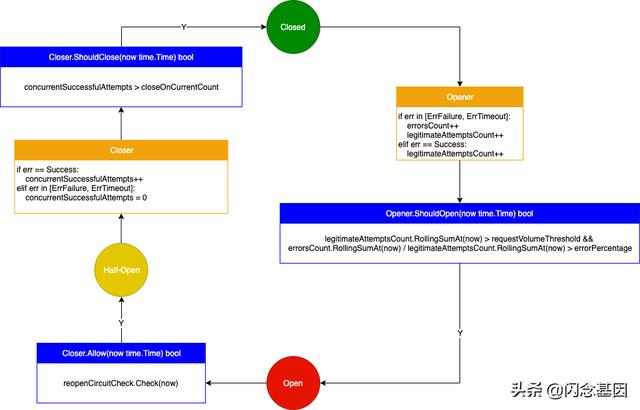 文章插图
文章插图
异常处理func (c *Circuit) Execute(ctx context.Context, runFunc func(context.Context) error, fallbackFunc func(context.Context, error) error) error 方法返回的 error 可能的情况有:
- runFunc 返回的 error , 包括 circuit.BadRequest
- circuit 返回的 - 当状态为“打开”: circuit.circuitError{concurrencyLimitReached: true, msg: "circuit is open"} - 当并发请求超过阈值:- runFunc 并发超过阈值: circuit.circuitError{concurrencyLimitReached: true, msg: "throttling connections to command"} - fallbackFunc 并发超过阈值: circuit.circuitError{circuitOpen: true, msg: "throttling concurrency to fallbacks"}
- fallbackFunc 返回的 error
- nil
- runFunc 返回的 error , 除了 circuit.BadRequest
- circuit 返回的
- runFunc 并发超过阈值: circuit.circuitError{concurrencyLimitReached: true, msg: "throttling connections to command"}
- 当状态为“打开”: circuit.circuitError{concurrencyLimitReached: true, msg: "circuit is open"}
- 当并发请求超过阈值:
- nil
- 当断路器进入“打开”状态时 , 启动下游服务健康检查定时器 , 通过模拟业务请求调用下游服务
- 如果调用成功了 , 并且累积成功调用次数达到一定阈值 , 此时 OpenToClosed.Allow(now time.Time) bool 根据一定概率返回 true , 断路器进入“半打开”状态
- 如果调用失败了 ,OpenToClosed.Allow(now time.Time) bool 返回 false
- 当断路器进入“半打开”状态
- 如果调用成功了 , 进行计数 , 达到阈值后 , 断路器进入“关闭”状态 , 并且停止下游健康检查定时器
- 如果调用失败了 , 断路器回到“打开”状态
package circuitimport ("math/rand""sync""time""github.com/cep21/circuit""github.com/cep21/circuit/v3/faststats")type ConfigureCloser struct {CloseOnSuccessfulAttemptsCount int64ReopenHealthCheck*HealthCheck}type Closer struct {reopenHealthCheck *HealthChecksuccessfulAttemptsfaststats.AtomicInt64closeOnSuccessfulAttemptsCount int64}func NewCloser(config ConfigureCloser) circuit.OpenToClosed {return &Closer{reopenHealthCheck:config.ReopenHealthCheck,closeOnSuccessfulAttemptsCount: config.CloseOnSuccessfulAttemptsCount,}}// start health check when circuit is openedfunc (c *Closer) Opened(now time.Time) {c.reopenHealthCheck.start()}// stop health check when circuit is closedfunc (c *Closer) Closed(now time.Time) {c.reopenHealthCheck.stop()}// half-openfunc (c *Closer) Allow(now time.Time) bool {return c.reopenHealthCheck.ok()}func (c *Closer) Success(now time.Time, duration time.Duration) {c.successfulAttempts.Add(1)}func (c *Closer) ErrBadRequest(now time.Time, duration time.Duration) {}func (c *Closer) ErrInterrupt(now time.Time, duration time.Duration) {}func (c *Closer) ErrConcurrencyLimitReject(now time.Time) {}func (c *Closer) ErrShortCircuit(now time.Time) {}func (c *Closer) ErrFailure(now time.Time, duration time.Duration) {c.successfulAttempts.Set(0)c.reopenHealthCheck.reset()}func (c *Closer) ErrTimeout(now time.Time, duration time.Duration) {c.successfulAttempts.Set(0)c.reopenHealthCheck.reset()}func (c *Closer) ShouldClose(now time.Time) bool {return c.successfulAttempts.Get() > c.closeOnSuccessfulAttemptsCount}type ConfigureHealthCheck struct {TickDurationtime.DurationRunfunc() boolThresholdint64AllowProbability int}type HealthCheck struct {runningboolstopSignalCh chan struct{}countfaststats.AtomicInt64musync.MutexconfigConfigureHealthCheck}func NewHealthCheck(config ConfigureHealthCheck) *HealthCheck {return &HealthCheck{stopSignalCh: make(chan struct{}),config:config,}}func (h *HealthCheck) start() {h.mu.Lock()defer h.mu.Unlock()if h.running {return}h.running = trueh.count.Set(0)go func() {tick := time.Tick(h.config.TickDuration)for {select {case
推荐阅读
-
-
-
-
-
-
-
-
-
-
-
-
-
-
-
-
-
-
-
-
- 亚马逊终止托管服务:Parler网站下线
- 大一非计算机专业的学生,如何利用寒假自学C语言
- Git服务器配置错误导致日产汽车源码在网上泄露
- 虾米音乐,下个月正式停止服务
- 虾米音乐播放器将于2月5日停止服务,今开启用户资产处理通道
- 服务|虾米音乐:2月5日关停3月5日后将无法登录
- 天猫精灵App全新升级,推出“精灵家”服务
- 快递员拒绝送货上门并大喊大叫!经济学者马光远吐槽德邦快递服务烂:流氓至此,坚决抵制
- 亚马逊宣布停止为Parler提供托管服务
- 亚马逊员工权益组织呼吁AWS拒绝为Parler提供托管服务